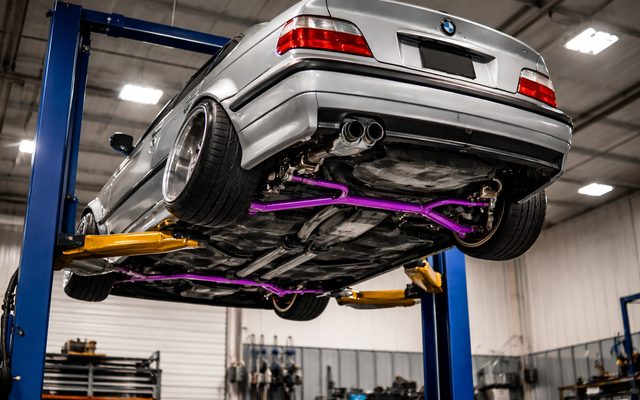
In the demanding world of contemporary serious sliding, podium finishes is no longer exclusively a result of raw engine power or driver courage. Conversely, it has become a intricate engineering challenge that requires a scrupulous blend of selecting a inherently capable car, equipping it with the most precise competition hardware, and, most importantly, grasping its real-time characteristics on the course through advanced vehicle dynamics analysis tools. This definitive guide will serve as your blueprint starting from the very first idea of a drift build right through to the last engineering-refined refinements that transform a powerful car into a predictable podium finisher. We will examine in detail the art and science of vehicle alignment optimization, illustrating how a state-of-the-art drift tuning app like GripDial eliminates assumptions and delivers unmatched visibility into your car's actual behavior.
The cornerstone of any exceptional drift machine is, undoubtedly, the platform itself. A select group of cars have earned renowned standing within the global sliding culture due to their built-in balance, strong design, and the enormous range of specialist components available. Selecting the right car is the initial and most important selection a builder will make. As an example, the BMW's E36 3 Series is commonly accepted as perhaps the the best all-around drift platforms of history. Its near-perfect balanced front-to-rear weight, coupled with a RWD setup and bulletproof straight-six engines, establishes a car that is simultaneously easy to handle for beginners and extremely effective in the hands of a pro competitor. The evolution of this concept, the BMW E46 platform, builds upon these attributes with a increasingly developed chassis, broader track for improved stability, and yet a greater degree of steering angle directly from the factory. A distinct formidable option in the top-level arena is the Corvette C6.
This American track weapon introduces a particular set of strengths to the drifting sport, including a light aluminum frame, a rear-mounted drivetrain component that aids in an excellent weight distribution, and the colossal low-end power of a big LS-series V8 engine. This fusion renders it an utter weapon on track, capable of entering and holding long drifts with relatively minimal deployment of power. For builders seeking remarkable bang-for-the-buck, the Nissan 350Z stands out as a prime candidate. It arrives from the manufacturer with a rigid chassis, a competent original LSD, and the smooth VQ series motor that provides ample horsepower and torque for practicing and progressing in the sport. Its newer version, the Nissan Z34, brings further refinements in structural rigidity, handling precision, and outright motor performance, solidifying its place as a common pick among serious pilots. Further iconic platforms that warrant attention encompass the lightweight unique Mazda FC, the ever-present Nissan S13 240SX, the torque-rich Ford SN95, the more recent BMW E90, and the compact yet surprisingly fun and forgiving MX-5 Miata. Every single one of these chassis provides a distinct palette of characteristics, difficulties, and capabilities, but they all have in common the core components necessary to be transformed into a serious drift car.
However, choosing the optimal platform is merely the first step. To access the true potential of every of these machines, major modifications to the steering system and chassis control systems are utterly mandatory. This is where the domain of specialist aftermarket parts comes into critical view. The most most impactful improvement for a dedicated competition vehicle is the installation of a maximum-angle drift angle kit. These advanced assemblies, such as those manufactured by industry leaders like SLR Speed, are created to radically enhance the chassis's maximum turning lock. A OEM road car is extremely limited in how far its tires can turn, a safety trade-off for on-road use. In oversteer driving, but, extreme opposite lock is constantly necessary to catch and maintain a slide. An modification kit substitutes the stock uprights, linkages, and potentially A-arms with pieces that allow the steered wheels to achieve steering lock beyond 70 or even 80 degrees, versus a typical factory limit of around 40 to 50 degs.
This vastly increased steering angle gives the driver with dramatically more control during a slide, allowing it to be much more straightforward to begin a oversteer moment, hold it through a sweeping bend, and transition fluidly from one angle to the other. The improvement in handling is truly transformative. Combined with a correctly chosen modification is the every bit as critical enhancement to the car's spring and damper setup. Store-bought or even high-end street adjustable suspension are just not designed for the particular and harsh requirements of drifting. A dedicated pair of adjustable dampers is paramount. These engineered coilovers have specific valving and spring rates that are designed for the rapid weight transfer that is typical of sliding. When a operator starts a angle, the chassis's mass is shifted forcefully to the outer of the turn. Optimal drift-spec suspension manage this transfer in a predictable manner, enabling the vehicle to find its balance quickly and providing the pilot precise feedback through the controls and driver's seat. They also allow for accurate setting of ground clearance, damping stiffness, and corner weighting, which are all integral elements of fine-tuning the vehicle's behavior to a given venue or competition style. As a system, a high-quality steering angle kit and a correctly selected pair of performance coilovers constitute the undeniable hardware cornerstone upon which all future tuning is built.
Once the fundamental components is in place, the next critical phase in the build is the meticulous adjustment of the chassis's wheel angles. This is the world of car suspension tuning, a methodology that can feel overwhelmingly complex to the beginner but is, in fact, the secret to transforming a set of high-performance components into a unified and predictable whole. The most critical parameter of suspension geometry for sliding is undoubtedly camber. Wheel camber is the inclination of the tire in relation to the vertical line when looked at from the front-on of the vehicle. If the top edge of the wheel is tilted towards the chassis, this is referred to as camber-in. For oversteer driving, inward-leaning wheels on the front axle wheels is widely used and is seen as necessary. The reason is deeply tied to physics.
When a chassis is turning at extreme sideways angles, the chassis rolls to the outer of the bend. This chassis roll causes the outer steering tire to lose its best contact patch with the asphalt. By adding negative camber, the wheel is pre-tilted to account for this lean. As the vehicle rolls into the corner, the outside front tire gains a better contact patch with the track, optimizing its traction at the precise point when it is absolutely essential for steering authority. Usually, front adjustments for a serious drift car fall between approximately -3 degrees to as high as -5 degrees or even greater, depending on the parameters of the car setup, compound selection, and driver feel. The rear axle wheels also use negative camber, but the values are typically less and less aggressive than the front axle. Overly aggressive camber at the back can cause the vehicle to extremely prone to oversteer and challenging to manage on power input, as it shrinks the available tire footprint of the driving tires during linear power delivery. Therefore, rear axle adjustments are frequently in the range of -1 degree to -3 degrees, striking a precise compromise between providing enough lateral bite to help in entering and sustaining the angle while simultaneously keeping usable hook-up for exiting the turn. Camber is merely one component of the more complex tuning puzzle, which additionally encompasses toe angle, caster, and bump steer correction.
Toe is the orientation of the tires as seen from above. Toe-in means the leading edges of the tires are closer together than the rear edges, while negative toe means the converse. For sliding, a modest amount of front axle negative toe is commonly used to quicken the initial response handling reaction, making the vehicle feel more nimble and willing to begin a oversteer moment. Rear axle toe is typically set to zero or a extremely small amount of positive toe to promote stability under acceleration. Caster is the forward or rearward tilt of the steering axis when observed from the lateral of the chassis. Increased positive caster improves steering feel and high-speed stability, and it furthermore adds to camber increase during cornering, which is extremely advantageous. Adjusting these values drift suspension tuning guide is a complex dance where a change to a single setting can and often will impact the other settings. The traditional process for setting a vehicle's alignment for competition has long been a labor-intensive process of experimentation and feeling. A pilot or crew would introduce a modification based on a hunch, test the chassis on track, depend on the driver's subjective sensation and impressions, and then make an additional tweak. This cycle would repeat over and over until the vehicle felt "right" or the scheduled practice period ran out. car suspension tuning This methodology is not only incredibly slow in terms of hours and costs, but it is also deeply imprecise.
Driver perception is a famously unreliable measurement tool, influenced by many elements such as exhaustion, changing track conditions, weather, and just the mindset of the pilot on that specific session. What feels "tail-happy" on one lap might feel "tight" on the subsequent run, resulting in confusing data and counterproductive changes. This age-old limitation in chassis setup is exactly where state-of-the-art technology has made its mark to revolutionize the methodology.
The advent and adoption of sophisticated drift telemetry software has brought about a new age for tuning and optimizing professional drift cars. These platforms, exemplified by groundbreaking systems like modern telemetry hardware, work by directly capturing the actual physical movement of the chassis as it is being driven on the circuit. In contrast to using subjective impression, these devices gather quantifiable information on essential parameters such as shock absorber movement, wheel speed, G-force loading, wheel angle, and driver input application. This raw telemetry is then processed by sophisticated applications that can plot and analyze the metrics in a actionable way. For the first time ever, drivers and crews can visualize exactly what the car is doing at each point of a lap. This function revolutionizes the whole alignment optimization process. Think about the specific challenge of setting the front axle negative camber for a given vehicle. As an alternative to introducing a modification from -3 degrees to -3.5 degrees and then running many passes to try and "perceive" a improvement, a telemetry system can give instant and clear data. The application can display graphically how the tire's contact patch is behaving during the key moments of a angle: turn-in, mid-corner, and transition. It can show if the existing angle is enabling the steering tire to keep maximum contact or if the tire is overloaded on its outer edge.
The system can then make data-driven recommendations for adjustment. Perhaps the data reveals that the outside front tire is even overworking its sidewall at -3.5 degrees of negative camber, indicating that an increase to inward lean, say -4 degrees, might be advantageous. On the other hand, the data might show that the tire is failing to achieving heat or that the inside shoulder is wearing excessively, which could point to that there is overly aggressive angle and a small decrease back to -3.2 degrees would be more optimal. This standard of granularity and useful intelligence was simply unattainable in the era of pure seat-of-the-pants setup.
The effect of utilizing a dedicated drift telemetry system reaches well beyond merely setting alignment. It serves as an invaluable damper adjustment manual that is specific to your specific car. When setting the rebound and compression settings on your suspension, rather than relying on general tips or copying another car's settings, you can use the data to see how the vehicle is reacting in response to your tweaks. The software can display the damper movement trace over a section of track, highlighting if the shocks are controlling the body movement effectively or if they are causing the chassis to oscillate excessively after a flick. It can assist in diagnosing challenges like excessive compression or losing droop, enabling you to introduce educated decisions to helper springs, damping rates, or stance. This methodology extends just as well to the complex art of suspension geometry optimization. Beyond camber angle, the system can offer data into how modifications to toe and caster are impacting the vehicle's handling during different parts of a lap. For instance, it can help you to find the best amount of front toe-out for your specific angle kit configuration and driving approach by analyzing the speed of turn-in response and the stability of the vehicle at maximum steering angle. This transforms the tool an incredibly effective vehicle dynamics manual that is dynamically informed by the actual dynamics of your personal chassis on the circuit. It moves the whole endeavor from a subjective skill into a repeatable development process.
Additionally, the value of a tool like modern telemetry is not restricted to experienced tuners with large budgets. For the club-level enthusiast, it acts as an powerful equalizer. It practically provides the tuner with the insight of a expert dynamics engineer without the typical expense. It accelerates the development time by providing definitive answers to challenges that would traditionally take countless track days of trial and error to solve. A builder can see how their particular chassis reacts to specific adjustments, gaining a more profound knowledge of car control in the journey. It also opens up high-level chassis dynamics concepts, enabling all drivers with the drive to perfect their vehicle to do so in a efficient and effective fashion. This is especially significant in a discipline like drifting, where engineering know-how has in the past been a tightly held advantage among elite crews. Today, that power can be in the garage of every dedicated builder.
In conclusion, the path to building and dialing in the ideal championship-contending sliding vehicle is a multi-stage mission that seamlessly blends proven mechanical wisdom with 21st-century data solutions. It begins with the strategic pick of a legendary chassis, then enhanced by the application of essential drift-spec parts like maximum-angle drift angle kits and expertly valved competition coilovers. The journey then moves into the precision realm of chassis dynamics adjustment, where parameters like negative camber, toe, and caster angle are meticulously set to complement the vehicle's modified hardware and the driver's individual needs. Finally, and what genuinely differentiates the modern methodology from the traditional methods, is the integration of a advanced suspension tuning application. This tool removes the approximation and inefficiency of purely feel-based adjustment by giving objective, live telemetry on how the chassis is really performing. It serves as an indispensable diagnostic aid, a actionable coilover setup manual, and a all-in-one vehicle dynamics tool. In unison, this complete approach leads to that every element of the competition vehicle—from the selection of the drift telemetry software platform to the last tweak on the damper—is refined for peak success on the track. It represents the complete progression of the art of drifting, bridging physical car control with data-informed suspension engineering to create the most competitive cars attainable.